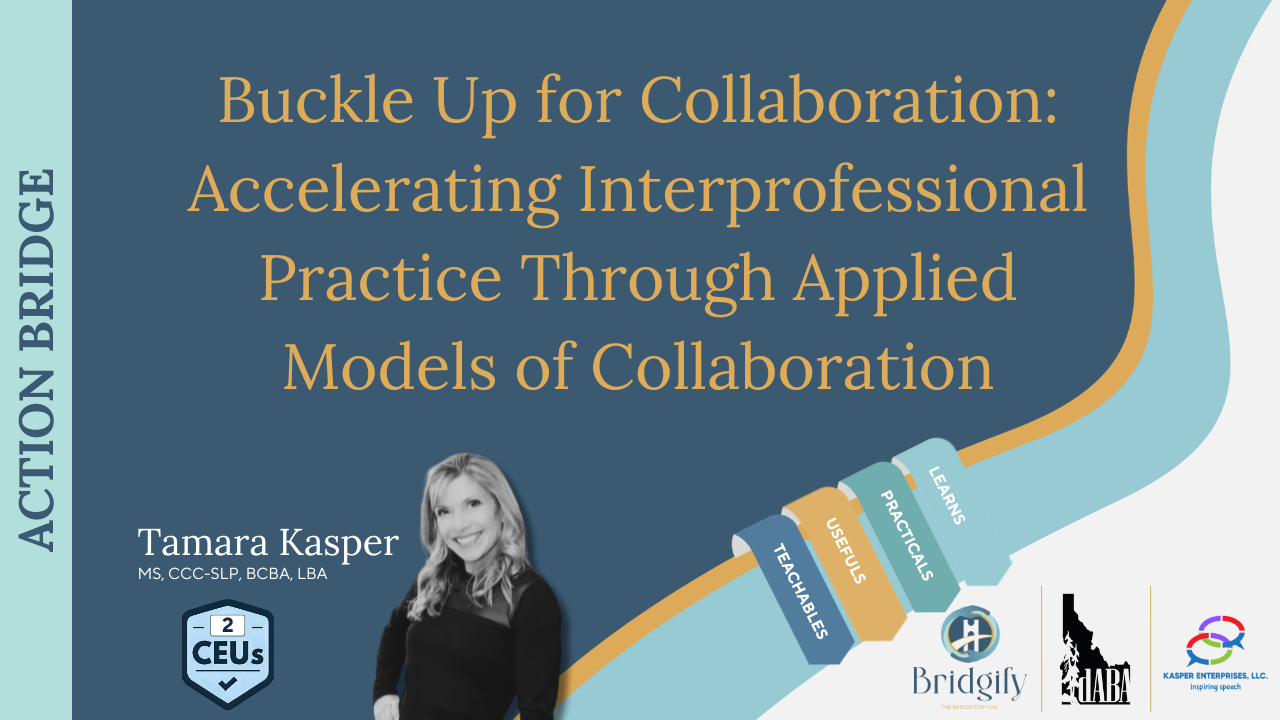
Action Bridge: Collaboration Interprofessional Practice
Collaborating across disciplines can be challenging due to differing jargon, theoretical orientations, and systemic barriers. However, when applied behavior analysis joins forces with speech-language pathology, client outcomes accelerate significantly.
In this Action Bridge, Tamara Kasper introduces practical, evidence-based tools for interprofessional practice: the Applied Model of Interprofessional Collaboration for Assessment (AMIC-A) and for Meetings (AMIC-M). Participants will learn how to systematically navigate ecological barriers, structure jargon-free team meetings, and evaluate clinical dosage using active learn units.
The Action Bridge features a longitudinal case study demonstrating how phonetic hand cues, multi-modal AAC, and natural environment training can transform speech clarity and functional communication for complex learners.
Learning Objectives
Upon completion, you will be able to:
• Align ethical standards for interprofessional collaboration across BACB and ASHA codes.
• Apply the AMIC-A framework to assess ecological, context, and person-centered variables.
• Conduct structured team meetings using the AMIC-M 13-step checklist.
• Determine dosage based on learn units and utilize phonetic hand cues for speech shaping.
Who is this for?
This Action Bridge is designed for BCBAs, BCaBAs, and SLP-BCBAs who collaborate on multidisciplinary teams or design communication programming for individuals with speech delays and complex communication needs.
This Action Bridge has been approved for 2.0 Learning CEUs by Bridgify LLC, ACE Provider #OP-25-11914, authorized by the Behavior Analyst Certification Board (BACB®). The CEU requirements are detailed in the Action Bridge - CEU Content & Disclosures modules.